
AI Execution Layer & Platform Powering Healthcare
Vi helps health systems and payers reach the right patients earlier, keep them engaged in care, and remove the operational friction that drives cost. Every action is traceable. Every outcome is measured.
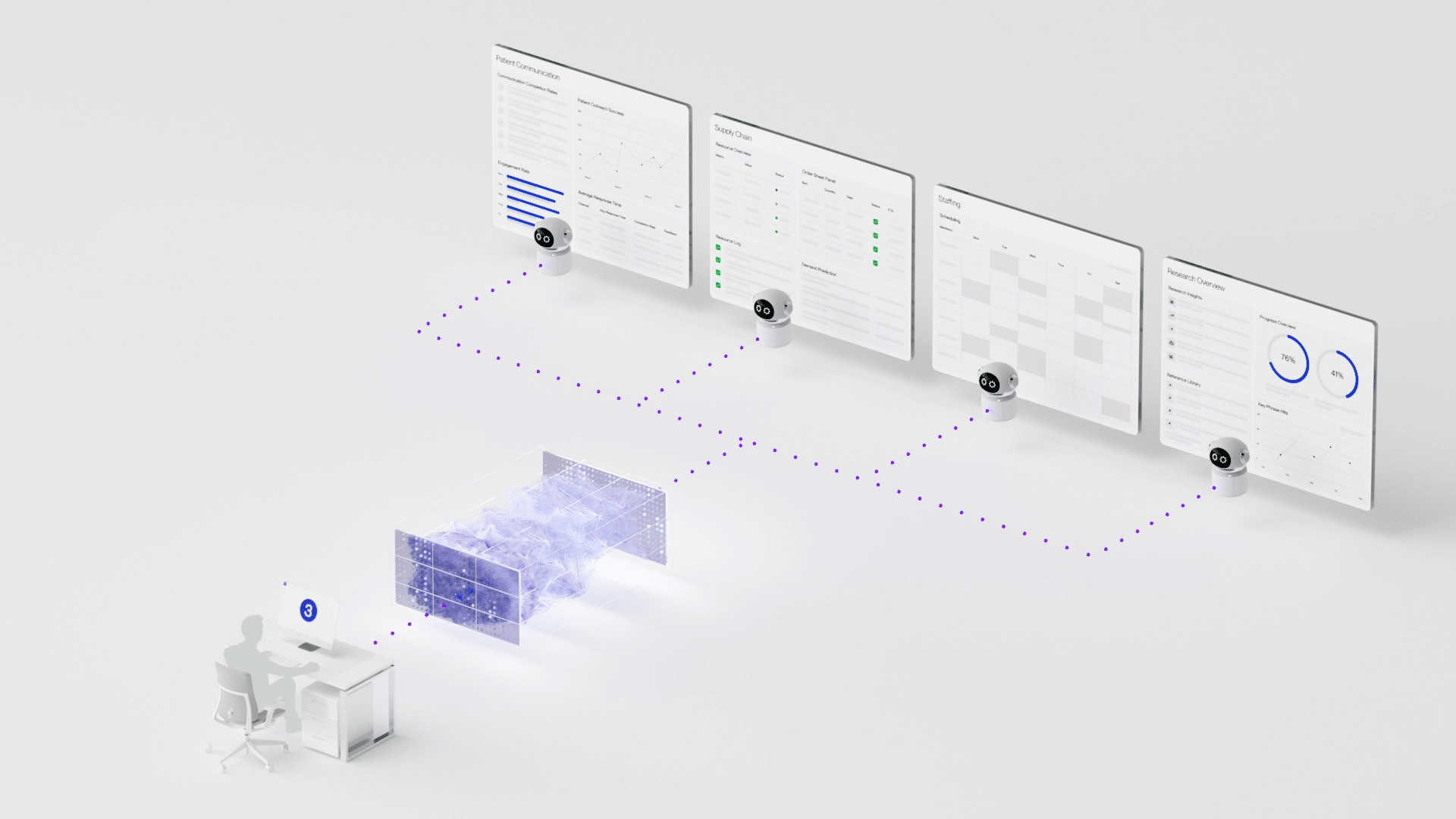
Health enterprises are not short on data. They are short on the ability to act on it in time. Insight arrives after the moment has passed, or lands in a system no one opens. Vi is the execution layer that closes the gap, predicting the next best action and triggering it inside the workflows your teams already run.
Results in Healthcare.
Reduction in patient activation costs
Boost in patient retention
Reduction in operational cost
Generated from new patients enrolled
AI built for enterprise health


Case Studies


Activating Patients in Fragmented Systems
A multi-site healthcare system was losing patients due to siloed outreach and lack of personalization. Vi Activate ingested operational and patient-level data to orchestrate smarter targeting and activation campaigns across regions, unlocking consistent ROI on patient engagement.
Reduction in patient activation costs
EHR systems unified through a single outreach platform
In cost reduction from fewer overtime hours


Increasing Member Engagement for Payers
A regional payer was seeing low preventive engagement and weak digital touchpoint usage. Vi Engage created personalized nudges, risk-based reminders, and omnichannel communication streams, driving both short- and long-term member value.
Uplift in new member enrollment
Increase in lifetime value (LTV)
Boost in preventive visit adherence


Operating Room Optimization
A large hospital system struggled to balance emergency vs. elective surgery volume. Vi Operate’s OR Scheduling Agent analyzed patient data and OR utilization in real time, reallocating resources dynamically to maximize throughput and revenue.
In annual revenue unlocked
From elective slot optimization
Boost in preventive visit adherence
Vi advantage

Enterprise-ready from day one.
Vi delivers what most life sciences organizations spend years building. A secure, purpose-built AI platform for health.

Deploys into what you already run.
No rip and replace, no IT burden, no interruption to clinical, commercial, or operational workflows.

Exclusive life sciences data advantage.
Vi’s models are fueled by licensed, de-identified data covering 96% of U.S. households, enriched by the Vi Data Web and tuned for trial recruitment, HCP engagement, and commercial decision-making.

Accountable to outcomes.
Vi commits to 4X return on every dollar spent, with 1X downside protection, backed by transparent control-group benchmarking. We win when our partners win.

Model-agnostic by design.
Vi brings newly released AI models into enterprise-ready products, so you get the best of every provider without lock-in to any.
Our security commitment
We adhere to and exceed data security standards, using anonymized data sets and rigorous protocols that ensure privacy and safety.



Frequently asked questions
-
What is an AI execution layer in healthcare?
An AI execution layer sits between the systems a health organization already runs and the actions those systems should trigger. It turns clinical, behavioral, and operational data into a specific next best action, delivered inside existing workflows. Vi is the AI execution layer for healthcare, life sciences, and wellness.
-
How is Vi different from a healthcare analytics or population health platform?
Analytics platforms produce insight. Vi produces action. Most tools stop at a dashboard or a risk score and leave execution to the team receiving it. Vi carries the prediction through to a triggered, governed, measurable action inside the systems already in use, then feeds the outcome back to improve the next prediction.
-
Does Vi replace our EHR, CRM, or data warehouse?
No. Vi runs alongside the systems already in place. Productized AI models deploy into existing infrastructure without a rip and replace, and Vi stays model agnostic so organizations can use third party models where those perform best. There is no lock in and no migration required to start.
-
What is a next best action in healthcare
A next best action is the most valuable step for a specific patient, or care team at a given moment: outreach before a care gap widens, a follow-up before an appointment is missed, a task routed before a discharge stalls. Vi predicts it from clinical, behavioral, and operational signals, then triggers it inside existing workflows.
-
What data does Vi use to predict patient and operational needs?
The Vi Data Web unifies de-identified clinical, claims, and operational data from enterprise partners with licensed real-world signals covering 96% of U.S. households. That combination surfaces what a record alone cannot: a rise in families searching online before a diagnosis, the patient quietly disengaging from a program, or the staffing gap forming three weeks out.
-
Is Vi HIPAA compliant?
Yes. Vi is HIPAA compliant and holds ISO/IEC 27001:2022, ISO/IEC 27701:2019, and SOC 2 Type 2 certifications. The Vi Data Web operates on de-identified data, and enterprise partner data is de-identified before use. Full documentation, including our data processing agreement and subprocessor list, is available at the Vi Trust Center.
-
How does Vi identify patients at risk of disengaging from care?
Vi detects behavioral change before it becomes a missed outcome. Delayed refills, missed appointments, declining digital activity, and shifts in routine are early indicators. The platform predicts likelihood to act and expected return, then the orchestration layer triggers outreach inside existing workflows. Detection and action are one continuous loop, not separate steps handled by separate tools.
-
What operational inefficiencies can Vi detect for my healthcare company?
Vi builds a real-time operational view from enterprise data, then acts on what it finds. The agentic layer surfaces staffing gaps and burnout risk, admission and discharge delays, manual handoffs, high-cost outliers, and supply chain waste, then routes tasks, adjusts schedules, and flags risk. Decisions requiring judgment escalate to a person.